The Foundation Settlement Problem in Thousand Oaks
Foundation settlement is one of the most common structural problems facing homeowners in Thousand Oaks and the broader Conejo Valley. The region's expansive clay soils—the same soils responsible for many of the area's landslides and hillside movements—absorb water during the wet season and expand, then dry out in summer and contract. That repeated cycle gradually compresses and destabilizes the soil beneath footings, allowing sections of the foundation to sink unevenly.
Hillside properties in communities like Lang Ranch and bordering Westlake Village face additional complexity: slope creep, grading fill that was never properly compacted, and lateral soil movement can all cause differential settlement that no surface-level repair will address long-term. When this kind of settlement is occurring beneath your home, the only permanent fix is to transfer your foundation's load past the unstable soil to stable bearing ground below—and that's exactly what steel pier systems do.
Our foundation settlement repair team installs both push piers and helical piers depending on your specific conditions. Understanding the difference helps homeowners participate meaningfully in the repair decision.
What Push Piers Are and How They Work
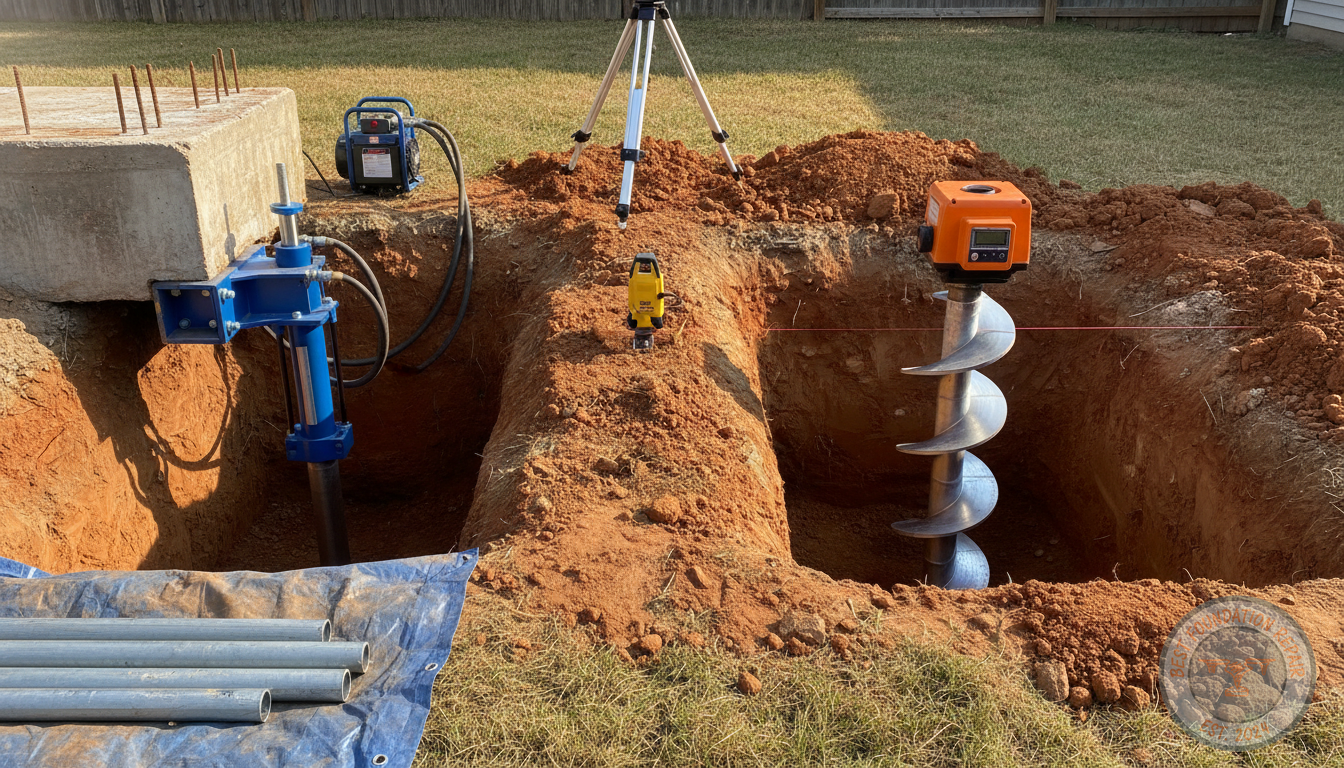
Push piers—also called resistance piers or hydraulic push piers—are steel pipe sections that are hydraulically driven vertically into the ground alongside your foundation. The driving force comes from the weight of the structure itself: a bracket is bolted to the existing footing, and a hydraulic ram pushes successive pier sections downward, using the building's load as resistance, until the pier reaches soil or bedrock with sufficient bearing capacity to support the structure.
Once all piers along the affected foundation section are installed to the required depth, hydraulic jacks at each pier head are used in a synchronized lift to transfer the building's weight from the unstable soil to the pier network. In many cases this lifts the settled section partially or fully back toward its original elevation. Steel shims are then inserted to lock the elevation permanently, and the pier head assembly is grouted and backfilled.
Push piers work best when:
- The structure is heavy enough to generate sufficient driving resistance—typically a standard single-family or two-story home with concrete or masonry foundation
- The footing is accessible for bracket installation (standard depth excavation of 2–3 feet)
- Stable bearing soil or bedrock exists at depth that can support the transferred load
- The goal is both stabilization and elevation recovery
What Helical Piers Are and How They Work
Helical piers use a different installation principle. Rather than being driven by compressive force, helical piers are screwed into the soil using a torque motor attached to an excavator or compact drive head. Each pier shaft has one or more helical (screw-shaped) plates welded to it; as the motor turns the shaft, the helices bite into the soil and pull the pier downward like a giant screw. Installation depth is determined by monitoring the torque required to turn the shaft—when torque readings reach the level corresponding to the required load capacity, the pier has reached competent bearing soil.
After installation, helical piers use the same bracket-and-lift methodology as push piers to transfer load and recover elevation. The key differences are in the installation process, which has significant practical implications for certain properties.
Helical piers work best when:
- The structure is lighter or the footing design doesn't generate enough resistance to drive push piers
- Access is limited—helical piers can be installed with smaller equipment in low-clearance spaces, tight side yards, or interior locations like crawl spaces
- New construction or pre-construction pier installation is planned before a structure is placed
- Tension applications are needed—helical piers resist both compression and uplift, making them useful for anchoring structures against lateral or uplift forces
- Soft or loose surface soils would cause push piers to buckle before reaching depth
Side-by-Side Comparison for Thousand Oaks Homeowners
Both systems are engineered permanent solutions with decades of performance data behind them. Here's how they compare on the factors that matter most to homeowners in our area:
- Installation speed: Both can typically be installed in one to two days for a standard residential application. Helical pier installation is somewhat faster in accessible conditions because drive torque monitoring eliminates the need to monitor driving resistance through a separate gauge.
- Equipment footprint: Helical pier equipment is more compact and can access crawl spaces, interior slabs, and tight side yards where push pier equipment cannot reach. If your settlement is occurring beneath an interior column or in a limited-access location, helical piers are usually the only viable option.
- Soil requirements: Push piers require the structure's weight to overcome soil friction—if surface soils are extremely soft or loose, pier sections may buckle before reaching depth. Helical piers don't depend on the structure's weight for installation and can be used in soft soil conditions.
- Elevation recovery: Both systems allow synchronized hydraulic lifting for elevation recovery. The degree of recovery achievable depends on how long settlement has occurred and how flexible the structure remains, not on pier type.
- Cost: Costs vary by site conditions, pier depth, and number of piers required. Neither system is uniformly less expensive—the right system for your conditions is the cost-effective one because it works correctly the first time.
Why the Soil Profile Beneath Your Home Determines the Choice
In the Thousand Oaks area, soil conditions vary considerably across relatively short distances. The clay soils in the valley floor behave differently from the decomposed granite and fill soils common on hillside lots. Some properties sit on fill placed during grading that may be 10 to 30 feet deep before reaching native bearing material. Others are on bedrock that is relatively shallow.
Our foundation specialists perform an on-site evaluation that includes reviewing available soil data for your address, probing soil conditions during excavation, and assessing the foundation type, footing dimensions, and load distribution. That information drives the pier type recommendation—not a default preference for one system over another. Homeowners in Thousand Oaks, Westlake Village, and surrounding Ventura County communities all get site-specific recommendations based on what the ground beneath their property actually requires.
Can Settlement Be Prevented in the First Place?
To a meaningful degree, yes. The most effective prevention strategies for Thousand Oaks homeowners involve managing water around the foundation:
- Ensure downspouts discharge water at least five feet from the foundation and away from the slope on hillside properties
- Maintain positive lot grading that directs surface water away from the house rather than pooling against stem walls
- Avoid overwatering landscaping immediately adjacent to the foundation, which keeps clay soils in a constant state of expansion
- Have retaining walls inspected periodically—our retaining wall repair page explains how failing walls on hillside properties can accelerate slope movement that reaches foundations
- Seal foundation cracks promptly before water infiltration further destabilizes soil beneath footings—see our foundation crack repair service for options
If your crawl space has moisture issues, our crawl space repair and encapsulation service addresses the moisture environment that accelerates wood deterioration in pier-and-beam foundations, complementing structural pier repairs with a complete moisture management system.
Schedule a Foundation Settlement Evaluation
If your Thousand Oaks home shows signs of settlement—sloping floors, sticking doors, diagonal drywall cracks, or gaps forming around windows—the most important next step is a professional evaluation that documents what's happening structurally and gives you a clear picture of your options. Best Foundation Repair provides honest, written assessments with no obligation to proceed.
- Call (805) 666-6371 — available Monday through Sunday, 8:00 AM to 6:00 PM
- Visit 75 E Thousand Oaks Blvd, Suite F, Thousand Oaks, CA 91360
- Email [email protected] to request an appointment
Early action on settlement means more options, more elevation recovery, and significantly lower total repair cost. Don't let a manageable problem become a major structural project—call Best Foundation Repair today.
Questions about foundation in Thousand Oaks, CA? We're happy to help — no sales pressure.
Talk to a Local Pro
Call +18056666371 or fill out our online form for a free, no-obligation quote.
Request Free Quote